





HARVARD CHINA PROJECT
Based at the Harvard School of Engineering and Applied Sciences
The China Project is a research program focused on China’s atmospheric environment, collaborating across schools of Harvard University and with Chinese universities. It conducts interdisciplinary, peer-reviewed studies related to air pollution and greenhouse gases in China, from root causes in the demand for and supply of energy to power its economy, to the chemistry and transport of pollutants in the atmosphere, to their impacts on human health and agriculture. The studies are designed to build knowledge and research capacities to help align China's domestic priorities on environment and development with equitable international strategies on climate change.
PROJECT NEWS
In the wake of severe air pollution levels recently in Beijing and other cities in northern China, an article in the WALL STREET JOURNAL spotlights a study by China Project researchers ZHAO Yu, Chris Nielsen, and collaborator ZHANG Jie. Led by ZHAO (now based in the Nanjing University School of Environment), the study evaluates the mixed success of pollution control and energy conservation policies on China's emissions of diverse pollutants and CO2 during 2006-2010. It appears in Atmospheric Chemistry and Physics. In the WSJ article, Zhao and Nielsen stress the importance of moving beyond high-profile targeting of one or two pollutant types or sectors, because of the role of many species, from many sources, in the secondary chemistry forming fine particles (PM2.5) and ozone.
*********************************************************************
A new study led by research associate LU Xi and China Project Chair Michael McElroy investigates the advantages of interconnecting offshore wind power bases along the coast of China to smooth power supply and ease its integration into China's regional electric grids.

Shown are correlation coefficients for hourly capacity factors of all pairs of 12 offshore wind power sites, grouped in Bohai Bay (BHB), the Yangzi River Delta (YRD), and the Pearl River Delta (PRD) regions. The upper left panel shows results for winter, upper right for spring, lower left for summer, and lower right for fall. It illustrates the opportunities to provide steadier power via interconnection of wind bases, exploiting differing simultaneous wind conditions over distance. The paper is submitted to Energy Policy.
*********************************************************************
How accurate are estimates of China's emissions of carbon dioxide?: Recent CO2 trends, spatial distributions, and uncertainties.

A China Project study (Zhao, Nielsen, and McElroy 2012) makes the first "bottom-up" estimates of China's annual CO2 emissions, for 2005-2009. Click here for the press release. Led by then-postdoc ZHAO Yu (now at Nanjing University), the research capitalizes on instrumental measurements of CO2 in smokestacks and of pollutants in the air by ground stations and satellites (Zhao et al. 2012b, 2011a,b,c, 2010, 2009; see publications). The study also quantifies the uncertainties of Chinese CO2 emissions, for the first time using rigorous statistical methods, yielding a 95% confidence interval of -9%, +11% for 2005. The research appears in Atmospheric Environment.
*********************************************************************
How much wind power could China ideally generate, given meteorology, geography and land uses, turbine technology, and current policies?
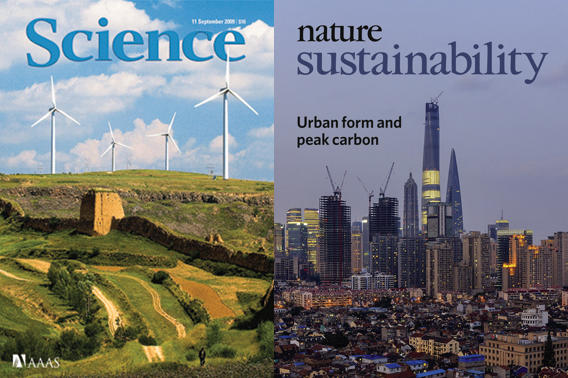
An assessment by China Project researchers of the total wind power potential in China was the cover article of Science.
This research is led by Project Chair Michael McElroy and post-doc LU Xi, taking advantage of NASA global meteorological datasets that have been validated by hundreds of studies of atmospheric transport and chemistry. It quantifies the meteorological, technological, and economic potentials of wind power under recent wind concession policies in China.
A good article on implications of and issues raised by the results is in MIT's Technology Review. The study has also been covered by the China Daily, major international newswires, and other news sources (links to a number of them here). See the wind power research page for more information and a related paper by the group in the Proceedings of the National Academy of Sciences (PNAS).
*********************************************************************
Check the reviews of Clearing the Air, the China Project book on the damages of air pollution, and comprehensive costs and benefits of taxes to control pollutants and CO2, edited by Mun HO and Chris Nielsen:

-
"The encouraging -- indeed, politically crucial -- observation is that ... 'green taxes' would yield a double dividend: reducing ... damage while enhancing economic growth. ... [That] should be an offer that a government cannot refuse" - Anthony J. McMichael, National Centre for Epidemiology and Population Health, The Australian National University, The Lancet (free registration)
-
Click here for more book reviews, by reviewers in health science, geography, economics, political science, history, and journalism.
- Order the book at MIT Press or Amazon or Barnes and Noble.
-
Click here for a description of the study and lead policy conclusion, including how to interpret national damage estimates such as premature mortality and percent of GDP. A new research phase is currently underway, integrating the framework of Clearing the Air with the Project's separately-developed capacities in atmospheric science, described here.
*********************************************************************
PROJECT INTRODUCTION
RESEARCH AREAS
China's Atmosphere: Sources, Transport, and Chemistry
Measuring Air Pollutants and Greenhouse Gases: Miyun Atmospheric Station
Wind Power Potentials
China's Economy and Energy Use
Clearing the Air: Health and Economic Damages of Air Pollution
Assessing Options to Control Greenhouse Gases and Air Pollutants in China
Urban Transport, Land Use, Air Quality, and Health in Chengdu
Environmental Law, Politics, and Culture
PUBLICATIONS
SEMINARS
PEOPLE
JOINING THE RESEARCH
OFFICES AND CONTACTS
Note: Except for listings of publication authors, this website observes Chinese name order, placing surnames in all-capitals for clarity.